

|

|
LATEST NEWS
|
|
See Rebecca's UPDATED
Education Aids
(Click here for information
on updates)
·
Incorporating the latest ultrasound research
·
New graphics & animations
·
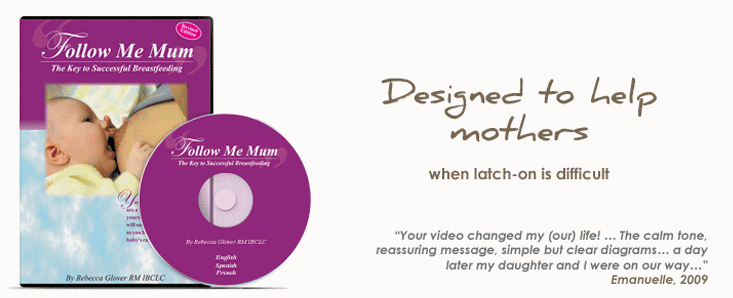
New DVD-Video "Follow Me Mum"
·
In English, Spanish, French
Rebecca will
be SPEAKING @
|
Breastfeeding:
"Nurturing the Normal - From Science to Practice”
An exclusive one day conference
covering the following topics:
* Keeping Mothers and
Babies Together
* Working with Innate
Infant Abilities
* Positioning and
Attachment in Practice
* How women learned -
then and now
* Nurturing the
normal - when attachment is difficult
* Baby Wearing
* Q&A
DATE:
Thursday 25th September, 2008
WHERE:
London Zoo Regents Park, London NW1 4RY
TIME:
08:30 -17:00
See expressyourselves.mums.co.uk
for details
|
Rebecca will
be EXHIBITING @
|
VELB/ ILCA Congress
October
1 - 3, 2008
Austria
Center, Vienna
See www.ilca.org for
details
|
|
Rebecca's Education Aids
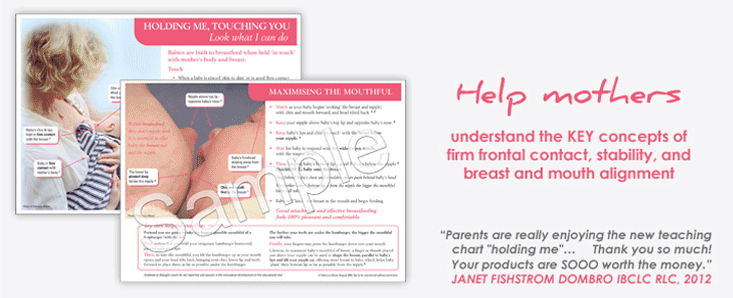
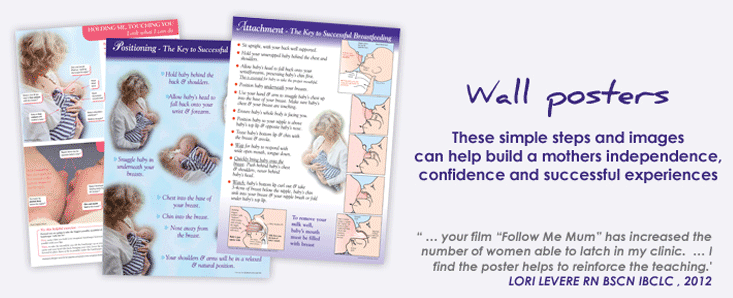
Teach Positioning & Attachment (latch) Technique by an empowering
combination of Unique Graphics and Clear Explanations.
The techniques described have been developed
from the current scientific evidence and Rebecca’s detailed observation of
the attachment/latch process over more than three decades of working with
breastfeeding mothers and their babies.
For an outline of the Evidence and Effects of these Techniques.
see L.A.T.CH.O. below - Learned Attachment Techniques CHanges Outcomes 
About the Author:
Rebecca Glover RN RM IBCLC
During her Midwifery training in 1970, Rebecca was taught a particular
technique for attaching babies that consistently produced a comfortable
breastfeeding relationship. Fifteen years later, the ultrasound studies of
M.W. Woolridge (Midwifery, 1986, 2., 164-176) described exactly why this
technique was so effective. This exciting new information prompted Rebecca to
become an International Board Certified Lactation Consultant (IBCLC) in 1989
and to begin her range of educational aids.
Rebecca runs a busy private practice in Perth, Western Australia, consulting
to mothers with breastfeeding difficulties (most related in some way to
attachment), teaching antenatal classes, conducting workshops and speaking to
health professionals.
Rebecca Glover
6 Finlay Crt
LESMURDIE WA 6076
AUSTRALIA
Ph / Fax:
Australia: 08 9291 7319
International Ph / Fax: +61 8 9291 7319
Email :
L.A.T.CH.O. -
Learned Attachment Techniques CHanges Outcomes
Breastfeeding Natural? YES! – Comes
Naturally? NO!
For a mother breastfeeding is a learned behaviour, but for her baby,
breastfeeding is instinctive.
Natures way for mothers to learn, is by subconsciously observing other
mothers holding, positioning, and attaching their babies successfully.
Unfortunately almost every human culture has interfered with this natural
process and today many women don’t have the opportunity to learn to
breastfeed naturally. Mothers certainly don’t understand how to work with
their baby’s innate behaviours, unless someone explains it to them.
Today, health professionals and lay counsellors in this field, play an
absolutely crucial role in replacing the loss of the natural process, by
teaching mothers attachment techniques that support innate infant behaviour
and the “mechanics” of breastfeeding.

Follow Me Mum, I do this instinctively!
Mothers need to know how to support and work with their baby’s instinctive
behaviours.
The first 3-4months of life is a unique period for the human infant. When
feeding behaviour is entirely instinctive and reflex and the infants anatomy
is uniquely matched to these behaviours.1.2.5.6.7. These reflex
behaviours are dependent on; appropriate sensory input, adequate positional
stability and the maturity and functionality of the physical structures
involved.
When 0 to 3-4 month old infants are provided with the appropriate sensory
input, (“skin to skin” or firm contact with the mothers’ body and breast)
they instinctively search for the breast by lifting their heads and thrusting
the chin and mouth forward, which in turn has the effect of tilting the head
backwards. This “Instinctive Position” or posture anatomically matches the
processes required for good attachment and the “suck-swallow-breathe” cycles
that are breastfeeding.1.2.3.4.
The Head tilt – extension or flexion
When a baby lifts the chin and mouth towards the breast, this has the effect
of tilting the head backwards. The perception that this puts the infant into
extension, rather than flexion, has caused a lot of consternation. Lift your
own chin and mouth as if searching for the breast and you will experience
that your cervical vertebrae stretch forward as your head tilts backwards.
When a baby is brought to the breast with their hips and shoulders against
mothers’ body, and lift their chin and mouth, to search for the breast, they
are simply stretching the cervical spine forward; a very different scenario
from extension, when a baby throws its head and shoulders back away from the
breast.

To make Good
Attachment physically possible babies need to be brought to the breast in the
“instinctive position”, where the mouth opens wide, the tongue
extends forward 1.2. and baby can “scoop” a large amount of breast
over the tongue and lower jaw. The nipple rolls back, close to the junction
of the hard & soft palate, and the breast fills baby’s mouth, with the
tongue & lower jaw positioned deep under the milk ducts and breast tissue
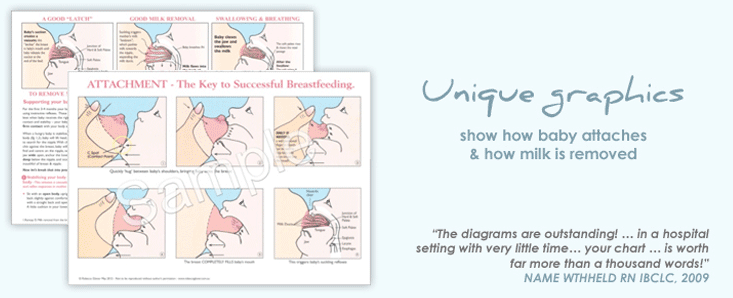
immediately behind the nipple. (see Rebecca’s unique graphics) Attachment is
not physically possible with the chin down, and try swallowing with your chin
dropped towards your chest!
With the essential mouthful in place, providing the appropriate
sensory input (everything touching in baby’s mouth) the infant
responds and uses the combination of; the mothers milk ejection reflex (pushing
milk into baby’s mouth) and increased negative vacuum, (created by the
lowering of the jaw & tongue during suckling) to comfortably and
effectively breastfeed.3.4.9.
The Magic of Positional Stability5.6.
|

|
The newborn infant is totally reliant on
external support, positional stability.
Without a stable base, function and mobility is less controlled or even
impossible. Therefore, for the infant to execute the complex oro-motor movements
required for attachment and breastfeeding they must be provided with the
appropriate stability.
Oral Stability is dependent on neck and shoulder girdle stability,
which are inturn, dependant on trunk and pelvic stability.5.6.
To support the reflex behaviours for effective Breastfeeding infants
require:
·
Midline
Stability – body centrally straight from head to toe The symmetrical
movement of the muscles on both sides of baby’s body is crucial for optimal
oro-motor function
·
Shoulder
Girdle Stability – firm support in the middle of baby’s body between the
shoulders. This stabilises the neck, head, jaw, tongue, pharynx &
larynx to enable controlled and effective oro-motor movement
·
Trunk
and Pelvic Stability – shoulders and hips turned towards and supported
against the mothers’ body.
When a
mother brings her nought to three to four month old baby to the breast in the
“instinctive position” AND provides them with the necessary positional
stability it triggers and supports the innate sequence of reflex behaviours
that are breastfeeding.7.
Watching a mother and baby put these learned techniques into practise, it is
pure magic to behold; especially when major attachment difficulties are
resolved through such a simple and empowering intervention.
References
1. Widström A-M et al. Gastric suction in
healthy newborn infants. Effects on circulation & developing feeding
behaviour. Acta Paediatr Scand 1987;76:566-72
2. Righard L. Alade M.O. Effect of delivery
room routines on success of first breastfeed. Lancet 1990;336:1105-07
3. Bergman N.J. Humans & Kangaroos – A
Biological Perspective. Conference Syllabus. ILCA 2003 Sydney. www.kangaroomothercare.com
4. Woolridge M.W. The ‘Anatomy’ of Infant
Sucking. Midwifery 1986;2:164-171
Woolridge M.W. Aetiology of Sore Nipples. Midwifery 1986;2:172-176
5. Wolf L.S. Glass R.P. Feeding and Swallowing
Disorders in Infancy: Assessment and Management. 1992 Therapy Skills Builders
6. Evans-Morris S. Klein M.D. Pre-Feeding Skills.
1987 Therapy Skills Builders
7. Glover R. Hold Tight – Feed Right. The
Promise of Positional Stability. Conference Syllabus. ILCA 2003 Sydney
Australia
8. Glover R. Lessons from Innate Feeding
Abilites Transforms Breastfeeding Outcomes. Conference Sylabus. ILCA 2004
Scotsdale Arizona USA.
9. Ramsay D.T. Hartmann P.E. Milk removal from
the breast. Breastfeeding Review 2005: 13(1): 5-7
© Rebecca Glover September 2005
May be copied for individual educational purposes only. All other
reproduction prohibited unless written permission is obtained from the
author.
|